

Creating a Lead Magnet Sequence That Actually Converts
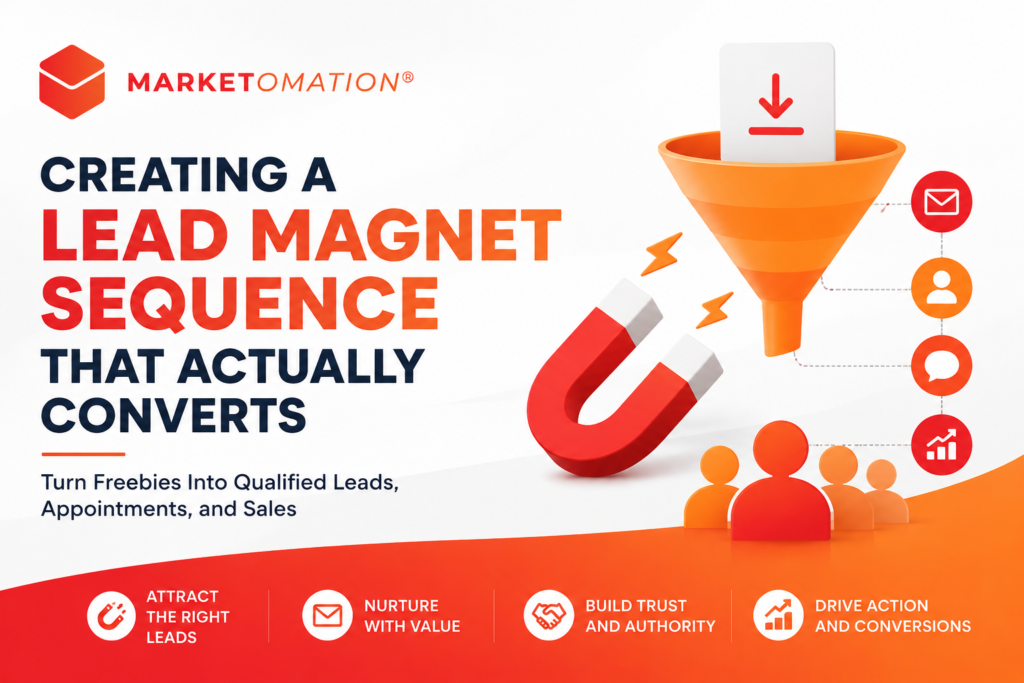
How to Turn Freebies Into Qualified Leads, Appointments, and Sales
If your lead magnet is generating downloads but not conversations, appointments, or revenue, the problem usually is not the lead magnet itself — it’s the sequence that follows it.
Most businesses spend all their energy creating the perfect checklist, guide, webinar, or template, then send a generic “Here’s your download” email and hope prospects magically convert.
They won’t.
A high-converting lead magnet sequence is designed to build trust, create momentum, establish authority, and guide prospects toward a specific next step.
In this article, we’ll break down exactly how to create a lead magnet sequence that actually converts visitors into qualified leads and paying customers.
What Is a Lead Magnet Sequence?
A lead magnet sequence is the automated series of emails, messages, and touchpoints that occur after someone opts in for your free offer.
Its purpose is to:
- Deliver immediate value
- Build credibility
- Identify buyer intent
- Educate prospects
- Overcome objections
- Move leads toward action
The sequence is often more important than the lead magnet itself.
A mediocre lead magnet with a strong follow-up sequence can outperform an amazing freebie with weak nurturing.
Why Most Lead Magnet Sequences Fail
Most sequences fail because they focus on information instead of transformation.
Common mistakes include:
- Sending too many promotional emails too quickly
- Providing value without direction
- Failing to create emotional engagement
- Not qualifying leads
- No clear call-to-action
- Generic messaging that feels automated
Your prospects are not looking for more information. They are looking for clarity, confidence, and results.
The Anatomy of a High-Converting Lead Magnet Sequence
A strong sequence follows a strategic progression.
Step 1: Deliver Immediate Value
Your first email should arrive instantly.
This email should:
- Deliver the promised resource
- Reinforce the problem your lead magnet solves
- Create anticipation for what’s next
- Encourage engagement
Example Subject Lines:
- Here’s Your Free Growth Blueprint
- Your Download Is Ready
- Start Here: Your First Step Toward Better Leads
Pro Tip:
Avoid overwhelming new leads with too much information immediately. Simplicity converts better.
Step 2: Build Trust and Authority
The second email should establish credibility.
Share:
- A client success story
- Your methodology
- A common mistake prospects make
- Why most solutions fail
People buy from businesses they trust.
Trust is built through:
- Consistency
- Clarity
- Demonstrated expertise
- Relatable storytelling
Step 3: Agitate the Problem
This is where many businesses stop too early.
If prospects do not fully understand the cost of staying where they are, they are unlikely to act.
Your sequence should help them recognize:
- Lost revenue
- Missed opportunities
- Inefficiencies
- Hidden frustrations
- Competitive disadvantages
The goal is not fear-based marketing.
The goal is awareness.
Step 4: Present the Solution
Only after building trust and clarifying the problem should you introduce your offer.
This could be:
- A consultation
- Demo
- Audit
- Strategy session
- Product trial
- Service offer
The transition should feel natural.
Instead of:
“Buy now.”
Position it as:
“Here’s the next logical step.”
Step 5: Add Social Proof
People trust outcomes.
Include:
- Testimonials
- Case studies
- Metrics
- Client wins
- Screenshots
- Video testimonials
Strong social proof reduces skepticism and increases conversion rates.
Example:
“After implementing this system, our client increased qualified leads by 47% in 90 days.”
Specificity builds credibility.
Step 6: Create a Clear Call-to-Action
Every email should have one primary action.
Not three.
Not five.
One.
Examples:
- Book a call
- Watch a demo
- Reply to the email
- Download a resource
- Complete an assessment
Confused prospects do not convert.
The Ideal Lead Magnet Email Sequence Structure
Here’s a proven framework:
| Day | Goal | Email Focus |
|---|---|---|
| Day 0 | Deliver Value | Resource delivery + expectation setting |
| Day 1 | Build Trust | Story + authority |
| Day 3 | Educate | Common mistakes + insights |
| Day 5 | Agitate Problem | Cost of inaction |
| Day 7 | Introduce Solution | Offer + benefits |
| Day 10 | Social Proof | Case study/testimonial |
| Day 14 | CTA Push | Clear next step |
This structure keeps momentum without overwhelming subscribers.
Best Types of Lead Magnets That Convert
Not all lead magnets perform equally.
The highest-converting lead magnets usually solve a specific, immediate problem.
Effective Lead Magnet Examples
Checklists
Simple and actionable.
Templates
Fast implementation creates quick wins.
Calculators
Interactive tools increase engagement.
Assessments
Excellent for lead qualification.
Playbooks
Position your business as strategic and authoritative.
Case Studies
Especially effective for B2B companies.
How to Increase Lead Magnet Conversion Rates
Segment Your Leads
Not every lead is at the same stage.
Segment based on:
- Industry
- Business size
- Behavior
- Interest
- Engagement
Personalized sequences consistently outperform generic automation.
Use Behavioral Triggers
Modern marketing automation platforms allow dynamic follow-up based on actions.
Examples:
- Opened email
- Clicked link
- Visited pricing page
- Watched webinar
- Booked call
Behavior-driven nurturing improves relevance and conversion.
Optimize Your Landing Page
Even the best sequence cannot fix a weak opt-in page.
Your landing page should include:
- Clear headline
- Strong value proposition
- Minimal distractions
- Social proof
- Simple form
- Mobile optimization
Focus on One Outcome
A lead magnet should solve one problem exceptionally well.
Trying to cover too much reduces perceived value.
Specificity converts.
Metrics You Should Track
To improve performance, monitor:
Opt-In Conversion Rate
How many visitors become leads?
Open Rates
Are subject lines compelling?
Click-Through Rates
Are prospects engaging?
Response Rates
Are people replying or interacting?
Appointment Conversion Rate
How many leads become conversations?
Revenue Attribution
Which lead magnets generate actual customers?
Data-driven optimization matters.
The Biggest Mistake Businesses Make
Most businesses create lead magnets for themselves instead of their audience.
Your prospects do not care about:
- Your process
- Your framework
- Your terminology
They care about:
- Results
- Simplicity
- Speed
- Clarity
- Solving a painful problem
The best lead magnets feel practical, relevant, and immediately useful.
Final Thoughts
A lead magnet alone will not grow your business.
What drives conversions is the strategic journey that follows.
A well-designed lead magnet sequence:
- Builds trust
- Educates prospects
- Creates momentum
- Qualifies buyers
- Increases conversions
- Shortens sales cycles
If your current lead generation strategy is producing downloads but not revenue, it may be time to optimize the sequence — not just the offer.
The businesses that win in modern marketing are the ones that create systems, not isolated campaigns.
Ready to Build a Lead Generation System That Converts?
At MarketOmation, we help businesses create automated marketing systems that attract qualified leads, nurture relationships, and drive measurable growth.
Whether you need:
- Lead magnet strategy
- Marketing automation
- Email nurturing sequences
- CRM optimization
- Conversion-focused funnels
We can help you build a scalable system designed for long-term growth.