
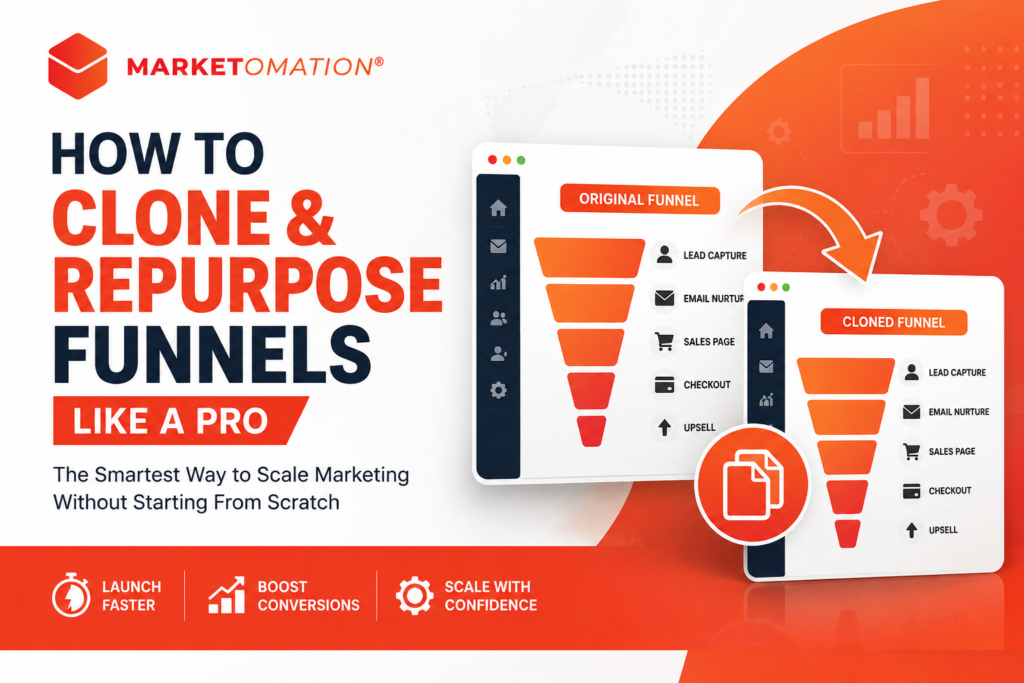
How to Clone & Repurpose Funnels Like a Pro
Building a high-converting funnel from scratch takes time, testing, creativity, and optimization. But once you finally have a funnel that works, most businesses make a costly mistake:
They reinvent the wheel every time they launch a new offer.
Smart marketers do the opposite.
They clone and repurpose funnels strategically so they can scale faster, reduce production time, and increase ROI without rebuilding everything from the ground up.
If you want to create more campaigns, launch faster, and maximize the performance of your existing marketing assets, this guide will show you exactly how to clone and repurpose funnels like a pro.
What Does It Mean to Clone a Funnel?
Cloning a funnel means duplicating an existing sales funnel structure, including:
- Landing pages
- Opt-in forms
- Email automations
- Sales pages
- Checkout pages
- Upsells and downsells
- Workflows and triggers
- Tracking and analytics
Instead of rebuilding each element manually, you duplicate the framework and customize it for a new audience, product, or campaign.
This gives you a proven starting point rather than beginning with a blank page.
Why Funnel Cloning Works
The best funnels are built on psychology, structure, and tested conversion principles.
When you clone a funnel correctly, you preserve:
- Proven conversion paths
- High-performing layouts
- Optimized messaging frameworks
- Effective automation sequences
- User behavior patterns
This allows you to launch new campaigns dramatically faster while maintaining consistency across your brand.
Key Benefits of Funnel Repurposing
1. Faster Launch Times
You can launch in hours instead of weeks.
2. Lower Marketing Costs
No need to redesign every campaign from scratch.
3. Better Conversion Rates
You’re using frameworks already proven to work.
4. Easier Team Scaling
Your team follows repeatable systems instead of reinventing processes.
5. Consistent Customer Experience
Your funnels maintain brand consistency across all offers.
The Difference Between Cloning and Copying
There’s an important distinction here.
Professional marketers don’t blindly duplicate funnels.
They clone the framework, then customize:
- Messaging
- Positioning
- Offers
- Visual branding
- Audience targeting
- Call-to-actions
The goal is not to create duplicates.
The goal is to create scalable systems.
The 7-Step Process to Clone & Repurpose Funnels Like a Pro
Step 1: Identify Your Winning Funnel
Before cloning anything, determine which funnel is actually performing well.
Look at metrics like:
- Conversion rate
- Cost per lead
- Customer acquisition cost
- Sales volume
- Average order value
- Email engagement
- ROI
Your best-performing funnel becomes your “master template.”
Pro Tip:
Don’t clone a funnel that hasn’t been optimized yet. Replicating a weak funnel just creates more weak funnels.
Step 2: Map the Entire Funnel Structure
Document every step of the customer journey.
This includes:
- Traffic source
- Landing page
- Lead magnet
- Email nurture sequence
- Sales page
- Checkout process
- Upsells
- Follow-up automations
Creating a visual map helps you identify which parts can stay the same and which parts need customization.
Step 3: Duplicate the Core Assets
Now clone the technical framework.
Depending on your platform, this may include:
- Funnel pages
- Automations
- Pipelines
- Tags
- CRM workflows
- Integrations
- Tracking pixels
- Analytics events
Most modern funnel platforms allow one-click duplication.
The key is maintaining the operational structure while preparing to tailor the messaging.
Step 4: Customize for the New Audience or Offer
This is where the real strategy happens.
You should update:
- Headlines
- Pain points
- Benefits
- Images
- Testimonials
- Calls-to-action
- Case studies
- Offer positioning
The framework stays consistent.
The communication becomes audience-specific.
Example:
A webinar funnel for real estate agents could easily be repurposed for mortgage brokers by changing:
- Industry terminology
- Client pain points
- Case studies
- Visual branding
The underlying funnel architecture remains nearly identical.
Step 5: Optimize the Traffic Source
Not every audience behaves the same way.
A funnel designed for Facebook traffic may require adjustments for:
- Google Ads
- YouTube
- Organic SEO traffic
- Email campaigns
Update:
- Hook messaging
- Ad creatives
- Landing page alignment
- User intent matching
The smoother the transition from traffic source to funnel, the higher your conversions.
Step 6: Update Automations & CRM Logic
This is where many businesses break their funnels accidentally.
Always review:
- Email triggers
- Contact tags
- Lead scoring
- Pipeline movement
- Notifications
- Calendar integrations
- SMS workflows
- Retargeting audiences
Automation errors can create:
- Duplicate emails
- Broken sequences
- Lost leads
- Poor customer experience
Professional funnel cloning includes full workflow QA testing.
Step 7: Test Before You Launch
Before driving traffic:
- Test every form
- Verify automation triggers
- Review mobile responsiveness
- Check payment processing
- Validate tracking
- Confirm email delivery
- Test redirects and thank-you pages
Never assume cloned funnels work perfectly automatically.
Even small technical issues can destroy conversions.
The Best Funnels to Repurpose
Some funnels are especially effective for cloning and scaling.
Webinar Funnels
Perfect for:
- Coaches
- Consultants
- Agencies
- SaaS companies
Lead Magnet Funnels
Great for list building across multiple industries.
Appointment Funnels
Ideal for high-ticket sales.
Challenge Funnels
Excellent for community-building and engagement.
E-Commerce Funnels
Useful for product launches and seasonal campaigns.
Common Funnel Cloning Mistakes
Mistake #1: Copying Without Strategy
A cloned funnel still requires audience alignment.
Mistake #2: Ignoring Mobile Optimization
Most traffic today is mobile-first.
Mistake #3: Forgetting Automation Updates
Broken workflows create lost revenue.
Mistake #4: Using Generic Messaging
Customization drives conversions.
Mistake #5: Launching Without Testing
Always QA every step before going live.
How AI & Automation Are Changing Funnel Repurposing
Modern AI tools are making funnel cloning faster and smarter than ever.
Today, businesses can use AI to:
- Rewrite landing pages
- Generate email sequences
- Personalize messaging
- Build automation workflows
- Create ad variations
- Optimize conversion copy
Combined with marketing automation platforms, businesses can now scale campaigns with unprecedented speed.
This is one of the biggest reasons why companies are increasingly turning toward automated marketing systems instead of manual campaign management.
Why Businesses Are Moving Toward Funnel Automation
The traditional approach to funnel building is:
- Slow
- Expensive
- Labor-intensive
- Difficult to scale
Businesses that automate and systemize funnel deployment gain a massive competitive advantage.
They launch faster.
They test faster.
They optimize faster.
And they scale revenue more efficiently.
Final Thoughts: Build Once, Scale Repeatedly
The highest-performing marketing teams don’t constantly start over.
They create:
- Proven frameworks
- Repeatable systems
- Automated workflows
- Scalable funnel architectures
Then they clone, customize, and optimize strategically.
That’s how modern businesses scale efficiently.
If your business is still rebuilding every funnel manually, you’re wasting valuable time, resources, and momentum.
The smarter approach is to create systems that let you build once — and scale repeatedly.
Ready to Automate & Scale Your Funnels?
At MarketOmation, we help businesses streamline marketing systems, automate workflows, and scale smarter using AI-powered marketing automation.
Whether you need:
- Funnel automation
- CRM workflows
- Lead generation systems
- AI-powered marketing
- Sales pipeline optimization
- Automated follow-up sequences
We help you build systems designed for growth.