

Reputation Automation: Collecting Reviews on Autopilot
In today’s digital-first marketplace, your reputation isn’t just important—it’s a primary driver of revenue. Prospects are researching, comparing, and deciding long before they ever speak to you. And what are they looking at? Reviews.
The challenge isn’t understanding the value of reviews—it’s consistently getting them.
That’s where reputation automation comes in.
This guide breaks down how to build a system that continuously collects high-quality reviews on autopilot—without adding manual workload or awkward follow-ups.
Why Reviews Are a Growth Lever (Not Just Social Proof)
Reviews influence more than perception—they directly impact:
- Conversion rates (buyers trust peer validation)
- Search rankings (Google prioritizes businesses with strong review signals)
- Customer acquisition cost (organic trust lowers ad dependency)
- Close rates (pre-sold prospects require less convincing)
In short: more (and better) reviews = faster, cheaper growth.
The Problem with Manual Review Collection
Most businesses approach reviews reactively:
- Asking randomly after a good interaction
- Relying on memory or team discipline
- Sending one-off emails that get ignored
This creates inconsistency and lost opportunities.
Even worse, timing is often off—requests come too late, or not at peak satisfaction moments.
What Is Reputation Automation?
Reputation automation is the process of systematically triggering review requests at the right moment, using workflows instead of manual effort.
It ensures:
- Every qualified customer is asked
- Timing is optimized for response
- The process runs without human intervention
Think of it as turning reviews from a hope-based activity into a predictable system.
The Core Components of a Review Automation System
To build an effective system, you need four key elements:
1. Trigger-Based Timing
Reviews should be requested at moments of high satisfaction, such as:
- After a purchase is completed
- Following successful onboarding
- Post-service delivery
- After a positive support interaction
Automations should be tied to these events—not random schedules.
2. Smart Segmentation
Not every customer should receive the same request.
Segment based on:
- Customer journey stage
- Satisfaction signals (e.g., NPS, survey responses)
- Purchase type or service tier
This ensures you’re asking the right people at the right time.
3. Multi-Channel Delivery
Relying on one channel limits response rates.
Use a mix of:
- SMS
- In-app or portal prompts
Short, direct messages outperform long-form requests.
4. Frictionless Review Experience
The easier it is to leave a review, the more you’ll get.
Best practices:
- Direct links to review platforms (Google, Yelp, etc.)
- Pre-filled prompts where possible
- Minimal steps to completion
Every extra click reduces conversions.
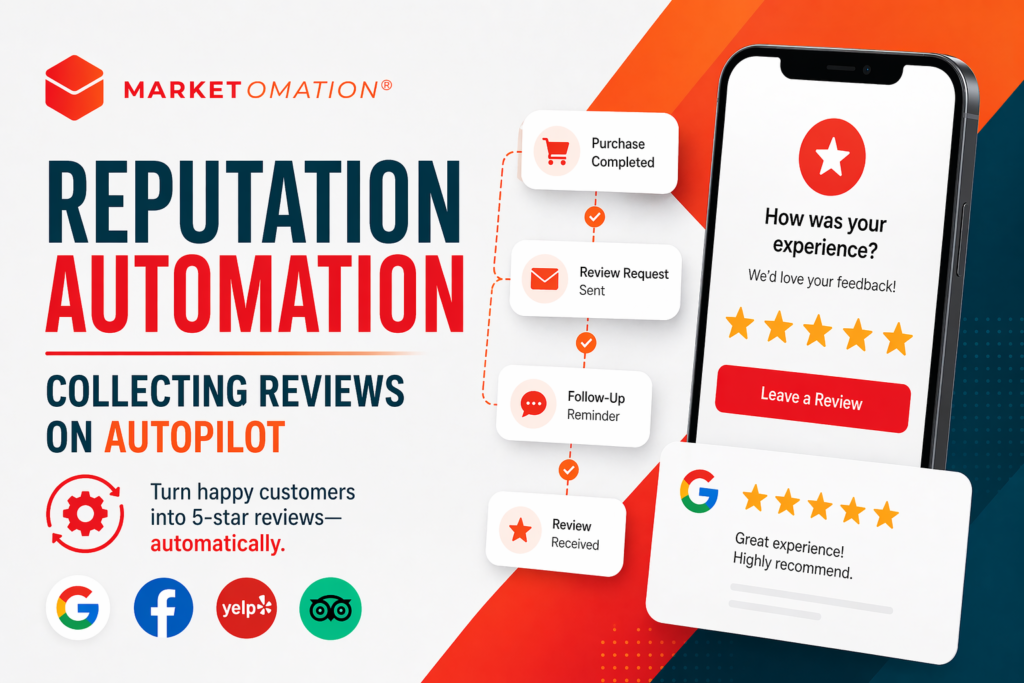
A Simple Automated Review Workflow
Here’s a high-performing baseline system:
- Trigger Event Occurs
- Example: Service completed or product delivered
- Delay Window (Optional)
- Wait 24–72 hours to allow experience to settle
- Initial Review Request
- Short message + direct review link
- Follow-Up Reminder
- Sent only if no response (2–3 days later)
- Conditional Logic
- Positive feedback → direct to public review platform
- Negative feedback → route to private feedback channel
This protects your public reputation while still capturing valuable insights.
Using Conditional Logic to Protect Your Brand
One of the most powerful aspects of automation is routing based on sentiment.
For example:
- Ask: “How was your experience?”
- If positive → send to Google review
- If neutral/negative → capture internally
This approach:
- Increases positive public reviews
- Prevents negative surprises online
- Gives your team a chance to resolve issues first
Scaling Review Volume Without Overwhelming Customers
More requests don’t always mean better results.
Focus on:
- Precision over volume
- Timing over frequency
- Relevance over repetition
You want consistent, natural inflow—not spam.
Metrics That Matter
Track these KPIs to optimize your system:
- Review request conversion rate
- Total review volume per month
- Average rating trend
- Response time to negative feedback
Small improvements here compound quickly.
Common Mistakes to Avoid
- Asking too early (before value is delivered)
- Asking too late (when momentum is gone)
- Sending generic, impersonal messages
- Not following up
- Ignoring negative feedback loops
Automation only works when the strategy behind it is sound.
Final Thought: Turn Reputation Into a System, Not a Gamble
Most businesses leave reviews to chance—and it shows.
When you implement reputation automation, you shift from:
- Inconsistent → Predictable
- Reactive → Proactive
- Manual → Scalable
At MarketOmation, we specialize in building these kinds of systems—where every customer interaction becomes an opportunity to strengthen your brand and drive growth automatically.
If your reviews aren’t growing, your system isn’t working. Fix the system, and the results follow.