

The Complete Guide to Automated Upsells & Downsells
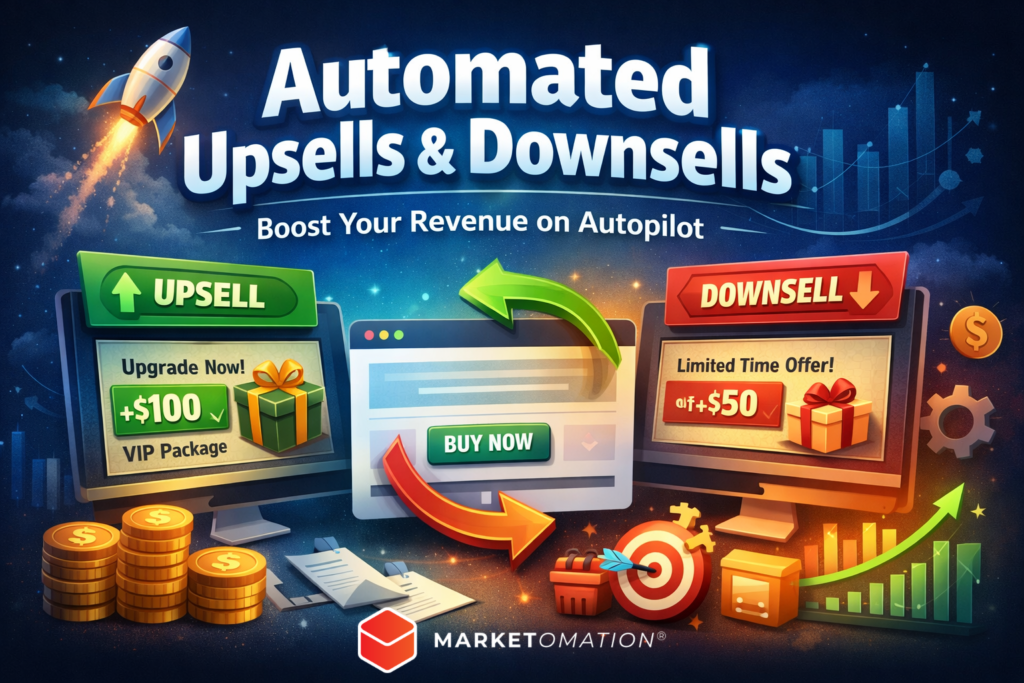
In today’s competitive digital landscape, increasing traffic is expensive — but increasing average order value (AOV) is one of the fastest ways to grow revenue without spending more on ads.
That’s where automated upsells and downsells come in.
When built strategically, automated post-purchase offers can increase revenue by 20–40% without adding friction to your funnel. This guide walks you through what upsells and downsells are, how they work, when to use them, and how to build high-converting automated sequences inside your marketing system.
What Are Automated Upsells & Downsells?
Upsell
An upsell is an offer presented after a customer commits to a purchase, encouraging them to upgrade or buy a higher-value product.
Example:
- Customer buys a $97 course
- You offer the $297 premium version with bonus coaching
Downsell
A downsell is a lower-priced or lower-commitment offer presented when someone declines an upsell.
Example:
- Customer declines $297 premium upgrade
- You offer a $147 version without coaching
Both are triggered automatically inside your funnel using behavioral logic.
Why Automated Upsells & Downsells Matter
Instead of focusing solely on new customer acquisition, upsells and downsells maximize revenue per transaction.
Key Benefits:
- Increase average order value (AOV)
- Improve customer lifetime value (CLV)
- Recover lost revenue opportunities
- Reduce ad spend dependency
- Monetize high-intent buyers immediately
If your funnel ends at checkout, you’re leaving money on the table.
Where Upsells & Downsells Fit in Your Funnel
The ideal flow looks like this:
- Core Offer Purchase
- One-Click Upsell
- If declined → Downsell Offer
- Confirmation Page
- Follow-Up Automation
This creates a dynamic offer stack that adjusts based on user behavior.
Types of Automated Upsells
1. Upgrade Upsell
Offer a premium or “pro” version of the product.
Best for:
- Courses
- Software subscriptions
- Memberships
2. Bundle Upsell
Offer complementary products at a discount.
Best for:
- E-commerce
- Digital templates
- Toolkits
3. Subscription Upsell
Convert one-time buyers into recurring revenue.
Best for:
- Supplements
- SaaS
- Membership communities
4. Fast-Action Bonus
Offer limited-time bonuses immediately after purchase.
Best for:
- Launches
- Coaching programs
- Digital products
Types of Automated Downsells
1. Payment Plan Downsell
If a buyer declines a full payment option, offer installments.
2. Lite Version
Offer a stripped-down version at a lower price.
3. Smaller Package
Reduce quantity or scope.
4. Entry-Level Offer
Offer a lower-tier product to keep the buyer in your ecosystem.
The Psychology Behind High-Converting Upsells
Automated upsells work because of:
1. Commitment Bias
Once someone purchases, they are psychologically primed to say yes again.
2. Momentum
The buying energy is highest immediately after checkout.
3. Perceived Value Stacking
When positioned correctly, the upsell feels like a logical next step — not an additional sale.
How to Structure a High-Converting Upsell Page
Your upsell page should be simple and focused.
Essential Elements:
- Clear headline reinforcing their first purchase
- Strong value-based positioning
- Bullet points highlighting benefits (not features)
- Risk reversal (guarantee)
- One-click acceptance button
- Smaller “No Thanks” link
Avoid:
- Long navigation menus
- External links
- Distractions
The goal is clarity and momentum.
How to Build Automated Upsells & Downsells
Inside a marketing automation platform like MarketOmation, you can build logic-based funnels that trigger offers based on behavior.
Step 1: Define Your Core Offer
Start with your primary product.
Step 2: Map Offer Logic
Example:
- If purchase → Show Upsell A
- If Upsell A declined → Show Downsell B
- If Upsell A accepted → Tag as Premium Buyer
Step 3: Use Behavioral Triggers
Automations can trigger based on:
- Purchase completed
- Upsell accepted
- Upsell declined
- Cart abandoned
Step 4: Apply Tags & Segmentation
Segment buyers based on:
- Accepted upsell
- Declined upsell
- Purchased via downsell
- Payment plan selected
This allows tailored follow-up campaigns later.
Best Practices for Automated Upsells
1. Keep It Relevant
Your upsell must directly enhance the original purchase.
Bad example:
Buying a fitness course → Offered unrelated business coaching.
Good example:
Buying a fitness course → Offered meal planning system.
2. Price Strategically
Upsells typically perform best between:
- 30%–100% of the original offer price
Downsells usually:
- 30%–50% lower than the upsell
3. Limit the Stack
Too many upsells create fatigue.
1–2 upsells + 1 downsell is typically optimal.
4. Use Scarcity Carefully
Fast-action bonuses convert well — but only if authentic.
5. Optimize for Mobile
A large portion of purchases happen on mobile devices.
Common Mistakes to Avoid
- Overcomplicating the funnel
- Offering irrelevant upgrades
- Using aggressive copy
- Forgetting to segment buyers
- Not tracking AOV performance
Automation without measurement is guesswork.
Metrics to Track
To evaluate performance, monitor:
- Upsell conversion rate
- Downsell conversion rate
- Average order value (AOV)
- Revenue per visitor (RPV)
- Customer lifetime value (CLV)
Even a 10% improvement in upsell acceptance can significantly impact overall revenue.
Example Automated Upsell Flow
Let’s say you sell a $97 digital course.
- Customer buys $97 course
- Upsell: $197 VIP version with bonus templates
- If declined → Downsell: $147 version without templates
- Tag buyers based on selection
- Trigger tailored onboarding email sequence
This creates intelligent segmentation while increasing revenue immediately.
Advanced Strategy: AI-Powered Offer Personalization
With modern automation tools, you can personalize upsells based on:
- Previous purchases
- Engagement behavior
- Traffic source
- Customer tags
- Spending history
Instead of one static upsell, you dynamically present the most relevant offer.
This dramatically increases conversion rates.
Final Thoughts
Automated upsells and downsells are not about being pushy — they’re about offering the right next step while buying intent is highest.
When structured properly, they:
- Increase revenue
- Improve customer experience
- Strengthen lifetime value
- Reduce reliance on constant lead generation
If your funnel stops at checkout, you’re underutilizing your highest-intent buyers.
Build smarter funnels. Automate intelligently. Maximize every transaction.