

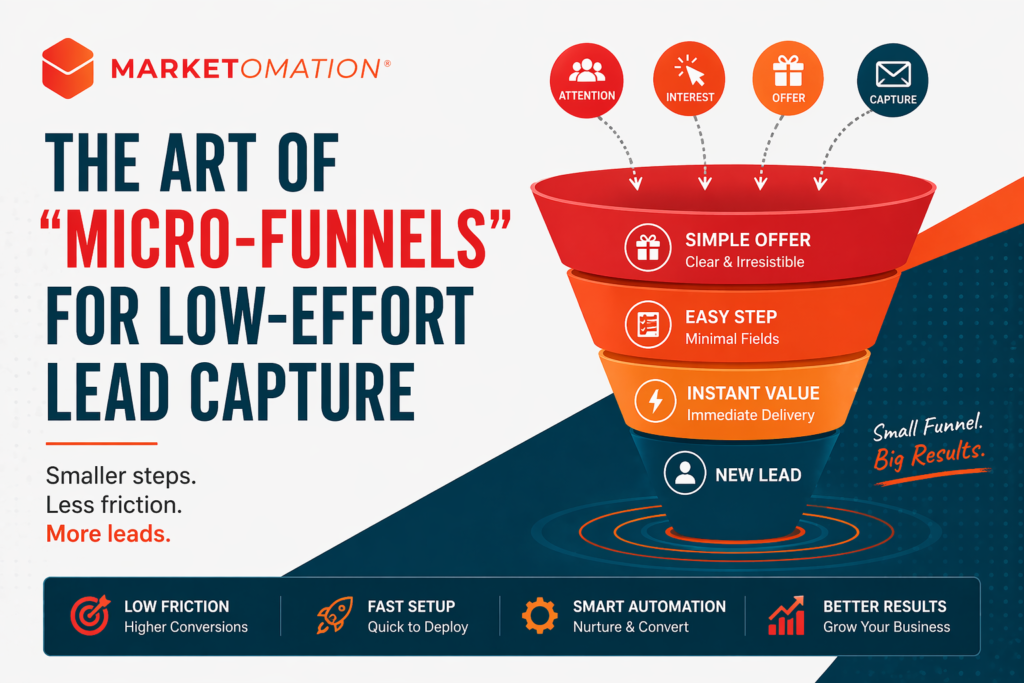
The Art of “Micro-Funnels” for Low-Effort Lead Capture
Most businesses overcomplicate lead generation.
They build multi-page funnels, long-form webinars, and complex automation sequences—only to see friction kill conversions before prospects ever engage.
Enter micro-funnels: streamlined, low-effort conversion systems designed to capture leads quickly, efficiently, and with minimal resistance.
In today’s attention economy, micro-funnels aren’t just a tactic—they’re a competitive advantage.
What Is a Micro-Funnel?
A micro-funnel is a highly focused, minimal-step conversion path that moves a prospect from attention to action in the shortest possible time.
Instead of:
- 5+ pages
- Long forms
- Multiple decision points
Micro-funnels prioritize:
- Speed
- Clarity
- Low commitment
Think of them as “conversion shortcuts.”
Why Micro-Funnels Work
1. Reduced Cognitive Load
Every extra step introduces friction. Micro-funnels eliminate unnecessary decisions, making it easier for users to say “yes.”
2. Mobile-First Behavior
Most users are browsing on mobile devices. Micro-funnels align with short attention spans and quick interactions.
3. Instant Gratification
Users expect immediate value. Micro-funnels deliver quick wins (downloads, results, insights) in exchange for minimal input.
4. Higher Conversion Rates
Shorter paths = fewer drop-offs. It’s simple math.
Core Components of a High-Performing Micro-Funnel
1. A Single, Clear Offer
No confusion. No multiple CTAs.
Examples:
- “Get Your Free Audit”
- “Download the Checklist”
- “See Your Score”
2. One Focused Landing Experience
This could be:
- A single landing page
- A pop-up
- A chat interaction
- A social media lead form
The key: one goal only
3. Minimal Input Fields
The fewer fields, the better.
Best practice:
- Email only (ideal)
- Name + Email (acceptable)
- Anything more = friction
4. Instant Value Delivery
Immediately after conversion:
- Deliver the resource
- Show results
- Trigger automation
No delays.
5. Automated Follow-Up
This is where the real funnel begins.
Micro-funnels capture the lead—automation nurtures it.
Types of Micro-Funnels You Can Deploy Today
1. Lead Magnet Micro-Funnel
- Ad or post → landing page → email capture → instant download
2. Quiz or Assessment Funnel
- “What’s your score?” or “Find out your result”
- High engagement, strong personalization
3. Chat-Based Funnel
- Website chatbot asks 2–3 questions
- Captures email mid-conversation
4. Social Platform Native Funnels
- Facebook/LinkedIn lead forms
- No external landing page required
5. Click-to-DM Funnels
- “Comment ‘INFO’ below”
- Automated DM delivers offer + captures lead
Micro-Funnels vs Traditional Funnels
| Feature | Micro-Funnel | Traditional Funnel |
|---|---|---|
| Steps | 1–2 | 5–10+ |
| Time to convert | Seconds | Minutes to hours |
| Complexity | Low | High |
| Setup time | Fast | Slower |
| Best use | Lead capture | Full sales journey |
Key Insight:
Micro-funnels don’t replace traditional funnels—they feed them.
Where to Use Micro-Funnels
Micro-funnels perform best at top-of-funnel entry points, including:
- Social media campaigns
- Paid ads
- Blog content upgrades
- Website pop-ups
- Email re-engagement campaigns
They act as “capture nets” across your ecosystem.
Common Mistakes to Avoid
1. Overloading the Offer
Trying to explain too much kills conversions. Keep it simple.
2. Asking for Too Much Information
Every extra field reduces completion rates.
3. Weak Follow-Up Systems
Capturing leads without nurturing them wastes the opportunity.
4. No Clear Next Step
Always guide the user:
- “Check your email”
- “Watch this next”
- “Book your call”
How to Build a Micro-Funnel (Step-by-Step)
- Define one outcome
(e.g., email capture) - Create a simple offer
(checklist, audit, score, template) - Build a single conversion point
(landing page, form, or chat) - Reduce friction
(limit fields, remove distractions) - Automate delivery + follow-up
(email sequence, SMS, CRM tagging) - Deploy across multiple channels
(ads, organic, website)
Advanced Strategy: Stacking Micro-Funnels
High-performing brands don’t rely on one funnel—they deploy many.
Example:
- Blog → content upgrade micro-funnel
- Instagram → DM automation funnel
- Paid ads → lead form funnel
- Website → pop-up micro-funnel
Each one captures a different segment of your audience.
Final Thoughts
Micro-funnels represent a shift toward frictionless marketing.
They respect the user’s time, reduce decision fatigue, and create fast entry points into your ecosystem.
When paired with strong automation, they become one of the most efficient lead generation systems available.
At MarketOmation, we focus on building scalable, automated micro-funnel ecosystems that turn attention into action—without complexity.