

How to Build a Simple Lead Scoring System in MarketOmation
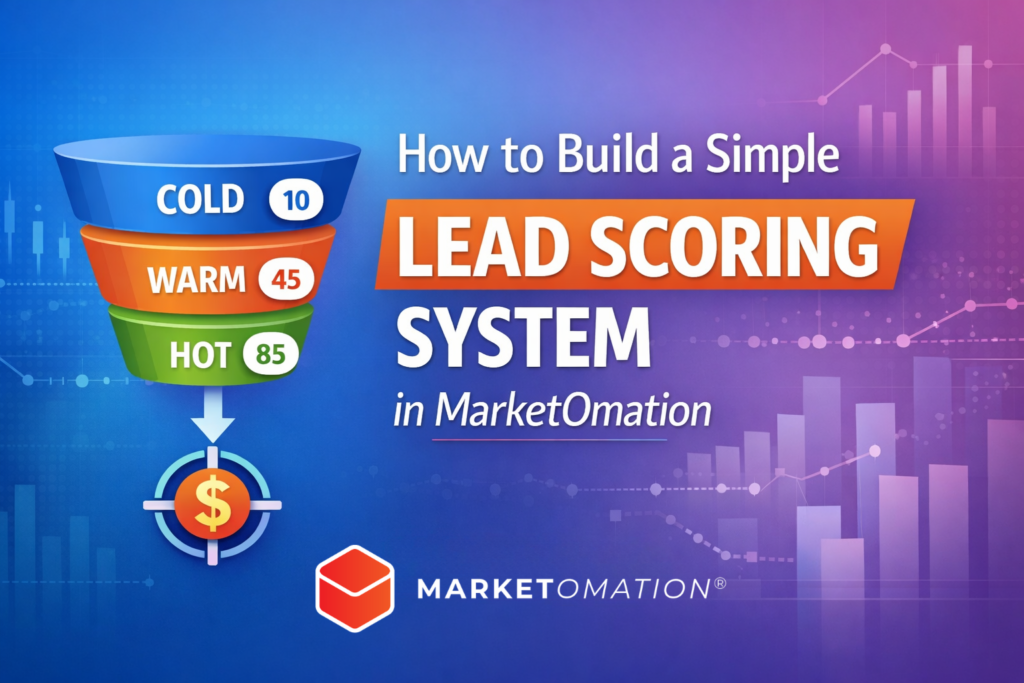
Not all leads are created equal. Some are just browsing. Others are actively evaluating and ready to buy. If your marketing automation treats them the same, you are leaving revenue on the table.
That is where lead scoring comes in.
In this guide, you will learn how to build a simple, practical lead scoring system inside MarketOmation—one that helps you prioritize the right prospects, automate smarter follow-ups, and improve conversion rates without adding complexity.
What Is Lead Scoring (and Why It Matters)?
Lead scoring is the process of assigning numerical values to contacts based on:
- Who they are (fit)
- What they do (behavior)
The total score helps you determine how sales-ready a lead is.
In MarketOmation, lead scoring acts as a decision engine. It allows your automation to answer critical questions such as:
- Who should receive high-intent offers?
- When should sales be notified?
- Which leads need more nurturing before outreach?
The result: better timing, better conversations, and better close rates.
Step 1: Define What a “Qualified Lead” Means for Your Business
Before touching automation, you need clarity.
Ask these questions:
- What actions signal real buying intent?
- What behaviors typically happen before a sale?
- What traits describe your ideal customer?
For most businesses, qualified leads share some combination of:
- Repeated engagement
- Content consumption
- Offer interaction
- Clear problem awareness
Document this definition first. Your lead scoring system should reinforce it—not guess at it.
Step 2: Choose the Right Behaviors to Score
A simple lead scoring system works best when it focuses on high-signal behaviors, not vanity actions.
High-Value Behaviors to Track in MarketOmation
Examples include:
- Visiting pricing or services pages
- Downloading a lead magnet
- Registering for a webinar
- Clicking links in nurture emails
- Requesting a demo or consultation
Avoid over-scoring low-intent actions such as:
- One-time homepage visits
- Social follows with no follow-up engagement
In MarketOmation, these behaviors are already trackable—your job is assigning meaning to them.
Step 3: Assign Simple Point Values
Resist the urge to over-engineer.
Start with easy-to-understand point ranges:
- Low-intent action: 1–5 points
- Medium-intent action: 10–20 points
- High-intent action: 30–50 points
Example Scoring Framework
- Email open: +2 points
- Link click: +5 points
- Lead magnet download: +15 points
- Webinar registration: +25 points
- Demo request: +50 points
This keeps your system transparent and adjustable as you gather data.
Step 4: Create Lead Score Thresholds
Once points are flowing, you need clear thresholds that trigger action.
A common structure inside MarketOmation looks like this:
- Cold Lead (0–24 points)
Early-stage awareness. Keep nurturing. - Warm Lead (25–59 points)
Engaged and learning. Introduce case studies, proof, and value-based offers. - Hot Lead (60+ points)
Sales-ready. Trigger sales alerts or direct conversion offers.
These thresholds allow MarketOmation automations to change behavior automatically as interest increases.
Step 5: Automate Actions Based on Lead Score
This is where MarketOmation shines.
Once lead scores are in place, you can automate responses such as:
- Moving contacts into different nurture sequences
- Sending internal notifications to sales
- Unlocking higher-intent offers or messaging
- Pausing low-intent leads from aggressive campaigns
Your automation stops guessing and starts responding intelligently.
Step 6: Keep It Simple—and Optimize Over Time
Your first lead scoring system does not need to be perfect. It needs to be useful.
Best practices:
- Review scores monthly
- Compare lead scores to actual conversions
- Adjust point values based on real outcomes
- Remove actions that do not correlate with sales
MarketOmation is designed to evolve with your data, not lock you into rigid logic.
Common Lead Scoring Mistakes to Avoid
- Scoring too many actions
- Treating all engagement equally
- Ignoring negative behaviors (such as unsubscribes or inactivity)
- Over-complicating logic before validating results
Simple systems outperform complex ones when they are actually used.
Why Lead Scoring Is a Revenue Multiplier
When implemented correctly, lead scoring:
- Improves sales efficiency
- Shortens sales cycles
- Increases conversion rates
- Aligns marketing and sales automatically
And in MarketOmation, it becomes the connective tissue between behavior, automation, and revenue.
Final Thoughts
You do not need enterprise-level complexity to benefit from lead scoring. You need clarity, consistency, and automation that responds to real intent.
By building a simple lead scoring system in MarketOmation, you turn your marketing engine into a prioritization engine—one that focuses your time, messaging, and offers on the leads most likely to convert.
If you want help mapping lead scoring into your broader automation strategy, MarketOmation is built to support that next step.