

Confident Launching: Building a Pre-Launch Automation Timeline
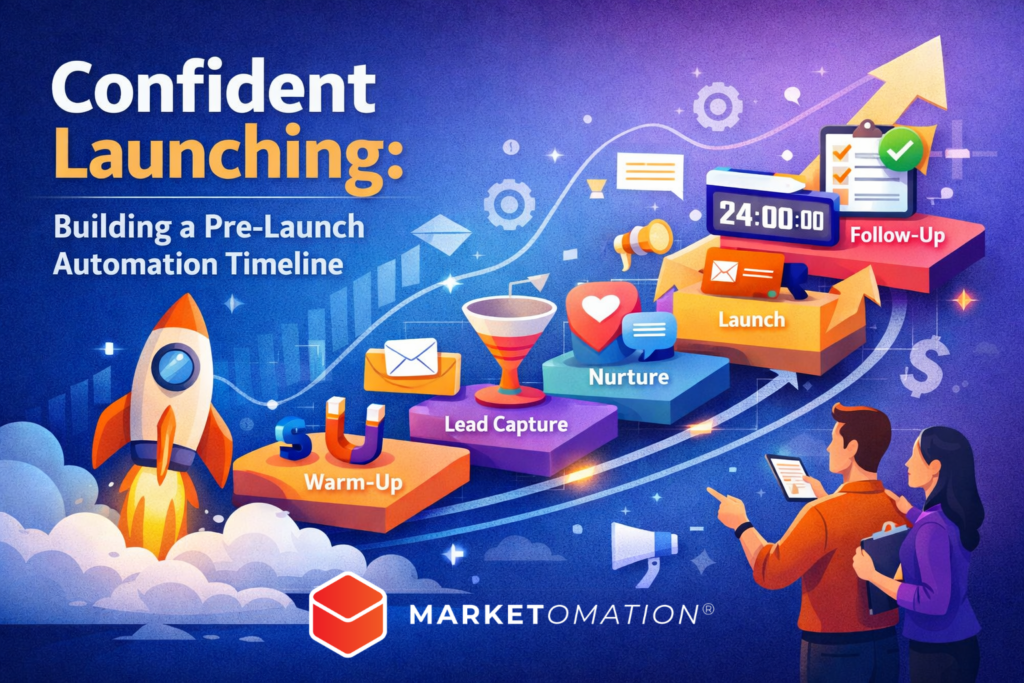
Launching a new product, service, or offer shouldn’t feel chaotic. Yet for many businesses, launches are reactive, rushed, and overly dependent on manual effort—leading to missed opportunities and inconsistent results.
A pre-launch automation timeline changes entirely. It replaces guesswork with a structured, repeatable system that builds anticipation, nurtures leads, and converts at scale—without burning out your team.
This guide breaks down how to design a high-converting, automation-driven pre-launch timeline that positions your offer for maximum impact.
What Is a Pre-Launch Automation Timeline?
A pre-launch automation timeline is a sequenced system of automated touchpoints—emails, SMS, retargeting ads, and behavioral triggers—designed to:
- Build awareness and anticipation
- Educate and nurture your audience
- Segment and qualify leads
- Drive conversions at launch
Instead of relying on one announcement, you orchestrate a multi-phase customer journey that gradually increases intent and urgency.
Why Pre-Launch Automation Is Critical
Without a structured timeline, launches typically suffer from:
- Low engagement (audience isn’t warmed up)
- Poor conversion rates (lack of trust and clarity)
- Operational stress (manual follow-ups and last-minute fixes)
With automation, you gain:
- Predictability – repeatable launch outcomes
- Scalability – reach more people without added workload
- Precision – deliver the right message at the right time
- Revenue lift – higher conversion through nurtured demand
The 5-Phase Pre-Launch Automation Timeline
A high-performing launch typically spans 2–6 weeks, depending on your offer and sales cycle. Below is a proven framework.
Phase 1: Audience Warm-Up (Weeks 4–6 Before Launch)
Objective: Build awareness and prime your audience.
Key Automations:
- Value-driven email sequences (education, insights, pain points)
- Social content distribution
- Lead magnets tied to your upcoming offer
- Pixel-based retargeting setup
Example Workflow:
- Day 1: Lead magnet opt-in → welcome email
- Day 3: Educational email
- Day 5: Problem agitation + soft positioning
Pro Tip:
Focus on problem awareness, not your product. You’re preparing the psychological groundwork.
Phase 2: Lead Capture & Segmentation (Weeks 3–4)
Objective: Identify high-intent prospects.
Key Automations:
- Quiz funnels or surveys
- Tag-based segmentation (interest, behavior, readiness)
- Conditional email paths
Example Segments:
- Highly engaged (clicked, watched, replied)
- Moderately engaged
- Cold leads
Why it matters:
Segmentation allows you to personalize messaging, dramatically improving conversion rates during launch.
Phase 3: Pre-Launch Nurture (Weeks 2–3)
Objective: Build trust and authority.
Key Automations:
- Case studies and testimonials
- Behind-the-scenes content
- Objection-handling sequences
- Webinar or event registration funnels
Automation Stack Example:
- Email → Webinar registration → Reminder sequence → Replay automation
Psychological Shift:
Move your audience from “This is interesting” to “This might be for me.”
Phase 4: Open Cart / Launch Window (Week 1)
Objective: Convert.
Key Automations:
- Cart open announcement (email + SMS)
- Deadline-driven sequences
- Abandoned cart recovery
- Behavior-triggered urgency (e.g., clicked but didn’t buy)
Critical Sequences:
- Day 1: Launch announcement
- Day 2–3: Value + FAQ
- Day 4–5: Social proof + urgency
- Final 48 hours: Scarcity + deadline reminders
Optimization Lever:
Use dynamic triggers:
- If clicked but didn’t purchase → send objection-handling email
- If inactive → send re-engagement message
Phase 5: Post-Launch Follow-Up (Week 2+)
Objective: Maximize lifetime value and recover missed opportunities.
Key Automations:
- Waitlist for next launch
- Downsell or alternative offers
- Onboarding sequences for buyers
- Feedback and survey collection
Revenue Recovery Strategy:
- “Last chance” replay sequences
- Extended payment plan offers
- Retargeting campaigns for non-buyers
Building Your Automation Timeline: Step-by-Step
1. Map the Customer Journey First
Before building automations, define:
- Entry points (ads, organic, referrals)
- Key decision milestones
- Friction points
This becomes your funnel architecture.
2. Define Trigger-Based Logic
Modern automation isn’t linear—it’s behavior-driven.
Examples:
- If user watches 75% of a webinar → send offer email
- If user doesn’t open emails → switch channel (SMS or retargeting)
- If user clicks pricing → trigger urgency sequence
This is where most businesses underperform—they rely on static campaigns instead of adaptive systems.
3. Align Messaging With Buyer Psychology
Each phase should match the buyer’s mental state:
| Phase | Mindset | Messaging Focus |
|---|---|---|
| Warm-Up | Curious | Problem awareness |
| Segmentation | Exploring | Relevance |
| Nurture | Evaluating | Trust & proof |
| Launch | Deciding | Urgency & clarity |
| Post-Launch | Reflecting | Opportunity & next steps |
4. Stack Channels for Maximum Impact
Don’t rely on email alone. High-performing launches use:
- Email (primary nurture channel)
- SMS (high urgency + open rates)
- Retargeting ads (reinforcement)
- Landing pages (conversion hubs)
This creates message frequency without fatigue.
5. Test Before You Launch
Run a pre-launch QA process:
- Test all triggers and conditions
- Verify segmentation accuracy
- Check timing delays and overlaps
- Simulate user journeys
A broken automation during launch can cost significant revenue.
Common Mistakes to Avoid
- Starting too late – insufficient audience warming
- Overloading content – too many messages, not enough clarity
- Ignoring segmentation – sending generic messaging
- No behavioral triggers – missing high-intent signals
- Weak follow-up – leaving revenue on the table
Final Thought
Confident launches aren’t built on hustle—they’re built on systems.
A well-designed pre-launch automation timeline transforms your launch from a stressful event into a predictable, scalable revenue engine. It ensures every lead is nurtured, every opportunity is captured, and every conversion path is optimized.
At MarketOmation, the focus is on turning complex marketing processes into streamlined, automated systems that drive consistent growth—so your next launch doesn’t just go live… it performs.