
Building a Community Funnel: How to Combine Membership, Content, and Events for Scalable Growth
Most funnels are built to convert.
The best funnels are built to connect, retain, and compound value over time.
That’s where a community funnel comes in.
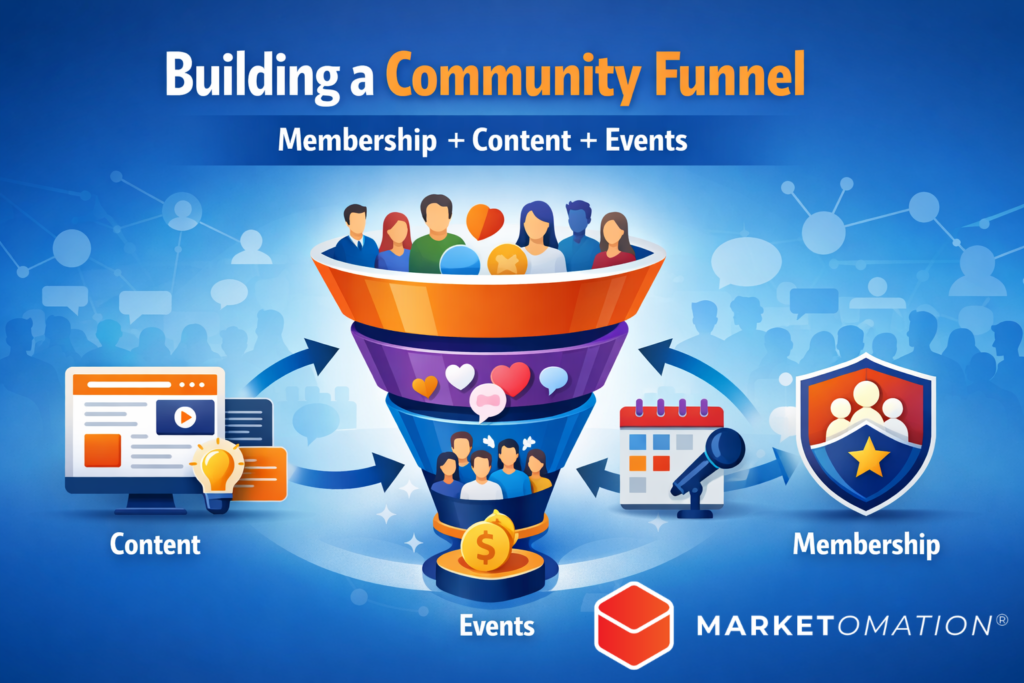
Instead of treating your audience like one-time leads, a community funnel turns them into engaged members, repeat buyers, and long-term advocates—by strategically integrating membership, content, and events into a unified ecosystem.
In this guide, you’ll learn how to design a community-driven funnel that doesn’t just generate leads—it builds momentum.
What Is a Community Funnel?
A community funnel is a growth system that moves people from:
Audience → Subscriber → Participant → Member → Advocate
It blends three core assets:
- Content (to attract and nurture)
- Events (to engage and activate)
- Membership (to retain and monetize)
Unlike traditional funnels, which end at conversion, a community funnel is circular and compounding—it increases lifetime value (LTV) and reduces acquisition pressure.
Why Community Funnels Outperform Traditional Funnels
Traditional funnels:
- Focus on short-term conversions
- Require constant traffic input
- Lose momentum after the sale
Community funnels:
- Increase retention and engagement
- Generate organic referrals
- Create recurring revenue streams
- Build brand authority and trust at scale
In practical terms, this means:
- Lower cost per acquisition over time
- Higher customer lifetime value
- More predictable growth
The 3 Core Components of a Community Funnel
1. Content: Your Top-of-Funnel Engine
Content is what pulls people into your ecosystem.
This includes:
- Blog posts (SEO-driven)
- Social media content
- Email newsletters
- Lead magnets
- Video and podcast content
Strategic goal:
Position your brand as a trusted authority while capturing leads.
Best practice:
Every piece of content should lead to a next step, not just provide value.
Examples:
- Download a guide
- Join a webinar
- Register for an event
- Enter your community
2. Events: Your Engagement Accelerator
Events are where passive consumers become active participants.
Types of events:
- Live webinars
- Workshops or trainings
- Roundtables or masterminds
- Virtual or in-person networking events
Strategic goal:
Create real-time interaction that builds trust and emotional connection.
Why events matter:
- They compress relationship-building into hours instead of weeks
- They increase conversion rates dramatically
- They naturally transition into offers or membership
Key insight:
Events are the bridge between content and community.
3. Membership: Your Retention & Monetization Engine
Membership is where your funnel becomes sustainable.
This could be:
- Paid communities
- Subscription programs
- Inner circles or masterminds
- Ongoing coaching ecosystems
Strategic goal:
Turn one-time engagement into recurring value and revenue.
A strong membership offers:
- Exclusive content
- Ongoing support or coaching
- Peer-to-peer networking
- Structured growth pathways
How to Structure Your Community Funnel
Here’s a simple, high-converting flow:
Step 1: Attract with Content
- SEO blog posts (like this one)
- Social distribution
- Lead magnets tied to specific problems
Step 2: Capture and Nurture
- Email sequences
- Personalized content journeys
- Segmentation based on behavior
Step 3: Activate with Events
- Invite leads to live or evergreen events
- Deliver high-value experiences
- Build trust quickly
Step 4: Convert into Membership
- Offer a clear next step into your community
- Position it as a continuation, not a sale
- Emphasize transformation and access
Step 5: Expand Through Community
- Encourage participation and connection
- Highlight wins and success stories
- Create referral loops
Automation Layer: Making It Scalable
A community funnel only works at scale if it’s automated correctly.
Key automation elements:
Lead Routing & Segmentation
- Tag users based on behavior (content consumed, events attended)
- Personalize follow-up sequences
Event Automation
- Registration → reminders → replay → follow-up
- Conditional logic based on attendance
Membership Onboarding
- Automated welcome sequences
- Guided first steps to increase retention
Content Recycling
- Turn events into content
- Turn content into lead magnets
- Turn discussions into insights
Common Mistakes to Avoid
1. Treating Content, Events, and Membership Separately
These must work as a system, not silos.
2. Overcomplicating the Funnel
Start simple:
Content → Event → Membership
3. No Clear Transition Points
Every stage should naturally lead to the next.
4. Ignoring Community Engagement
A membership without engagement becomes churn.
Example Community Funnel in Action
A simplified model:
- Blog post → “How to Scale Your Funnel”
- CTA → Free workshop registration
- Workshop → Deep dive + strategic insight
- Offer → Join a paid community or mastermind
- Inside community → Ongoing training + networking
- Members → Refer others → loop continues
Final Thoughts
The future of funnels isn’t just conversion—it’s connection and continuity.
A well-designed community funnel:
- Builds deeper relationships
- Increases retention and revenue
- Turns your audience into a growth engine
If you’re still relying on one-dimensional funnels, you’re leaving long-term value on the table.
The opportunity is to build an ecosystem—not just a pipeline.
At MarketOmation, we focus on designing automated systems that don’t just convert—but scale relationships, engagement, and revenue simultaneously.